
33
The telephone repairman with white helmet, indigo work clothes, and belt with clippers, wires, gadgets, and meters – who is attached to the telephone pole outside at the same level as the balcony, and is nestled within the telephone pole wires with a clear sight line from where I am now sitting – almost blends into the powder blue and lightly clouded sky. If the light changes a bit he might disappear and I would see wires moving and attaching to one another of their own volition.

32
Earlier while heading west I saw a man wearing a backpack and technical vest photographing a willing cat on the north side of the Shakujii gawa with an expensive digital single-lens reflex camera. Shortly afterward on the south side of the river I saw a different man (I think) in knee length shorts holding a small plastic grocery bag in his left hand while leaning precariously over a bush to photograph an awkwardly located flower stem with the mobile phone in his right hand. Now I hear the sharp sounds careening off the river embankments of someone clipping their fingernails indicating that unfortunately, personal grooming is publicly taking place somewhere off in the distance beyond the river bend. Perhaps later in the day I will come across a small pile of waning crescent moons further west.
31
I am still thinking about Disneyland Park in California in 2003, but also thinking about Tokyo Disneyland in Japan in 2005, Walt Disney World’s Magic Kingdom in Florida in 2006, and getting stopped by Magic Kingdom security in 2009. I am considering visiting Tokyo Disneyland once again as the gray of winter approaches. The gray of the painted ground in Tokyo Disneyland would match the sky and my 18% gray card perfectly, much more perfectly than in all the other Disneylands and Disney Worlds. Although they are collectively "The Happiest place on earth," they are not always the most scrupulously clean places on earth, which is absolutely necessary to achieve an even 18% gray. Waste is not visible, or acceptable at Tokyo Disneyland, which creates an overwhelmingly powerful curiosity deep inside me to see what is at the heart of their garbage dumpsters.


30
Just down the street from the local サミット (Samitto - Summit) supermarket there is a surveillance camera in front of the Kōban (neighborhood police station). Seeing the round dome of the camera housing nestled discreetly amongst the streetlights got me thinking about how the villainous HAL 9000 computer from Stanley Kubrick's 1968 film 2001 looks almost exactly the same. I once saw HAL living in a parking garage in Disneyland Park in Anaheim, California in 2003 when he migrated out of the film and into the real world (if we consider Disneyland Park as a part of the real world – or is it an intermediate step for migratory characters from films?). So, now HAL possibly lives in Takinogawa. I am curious if HAL was still capable of reading lips in 2003 as in the film and if it understood what I was conspiratorially communicating to it in that inky Californian parking garage at the end of the day.
...When the nights dark, we can both despise
Policemen and lamps as well.
There are bright lights in the dazzling eyes
Of beautiful Daisy Bell.

...When the nights dark, we can both despise
Policemen and lamps as well.
There are bright lights in the dazzling eyes
Of beautiful Daisy Bell.

29
On Sundays I sometimes go to Narita Airport to photograph the people photographing the jets and the people photographing their children photographing the jets from the outdoor observation deck. Today I am thinking about that Austrian Airlines jet that just arrived from somewhere. Also, I am thinking about traveling from New York to Vienna to see The Third Man on January 17, 2003 at 7:44 AM and the jet bridge stretching out to meet the Japan Airlines jet that was next to me. Could there have been a hatsumelo warning song as the jet bridge pulled away from the aircraft? If the hatsumelo for the Japan Airlines jet flying to Vienna were in fact the theme from The Third Man, then what Japanese film might have been referenced in my plane's departure song as the jet bridge pulled away? On that note, could Austrian Airlines hatsumelos for jets departing Vienna for Narita possibly play Kojun Saito's theme from Yasujirō Ozu's 1953 film Tokyo Story?


28
I am sitting at the kitchen counter watching the 14:30 JST afternoon light illuminate my beer and pondering how each weekend in Vienna Harry Lime and Holly Martins are resurrected when the film The Third Man screens. Orson Wells (Harry Lime) and Joseph Cotten (Holly Martins) both previously starred in Citizen Kane where they played close friends. Watching The Third Man one can't help but sense their friendship leaking out from Citizen Kane and into The Third Man. I decided to screen the two films consecutively and marveled at the extraordinary saga of a tumultuous and shifting friendship with characters that argue, age, die, reappear, are thought to be dead, then reappear again and argue before finally dying. I specifically chose an icy cold Ebisu beer rather than my usual Sapporo to commemorate the occasion. The long yellow streaks of late afternoon light across the white counter top and intensified through my glass of beer serve as a lovely tribute to the strange longevity and richness of their friendship.


27
It turns out that the Ebisu Hasumelo for the Yamanote actually IS the theme from the Carol Reed’s film The Third Man. I can’t believe that I stumbled into being correct. Very much like the film's bumbling quasi-protagonist Holly Martins.
26
Heading home late at night I stop at a street corner to wait for the light to change and a white dog suddenly appears in my peripheral vision behind a plate glass window. At first I thought that the dog was standing in a bank (the sign on the marquee said Softbank), so I asked the dog about the economic situation in Japan. The dog responded that it did not train in economics – woof – but in communications – woof – hence its current position as representative for a cellular phone company – woof. I asked the dog if communications was an interesting field to work in and the dog stated that it simply wasn't interested in talking to me, or anyone, because linguistically expressing one's deepest beliefs was such treacherous terrain – woof – woof. I stood there, mouth agape, momentarily stunned by the brusqueness of the response. It was without doubt a reluctant spokesperson / spokesanimal. I was channeling the friendly dog Hachiko from a classic Japanese story about loyalty, but it turns out that it wasn't the real Hachiko and that I was only talking to an inflatable corporate mascot that didn't want to get its plastic paws dirty. I was projecting, which was a chancy endeavor at best. Once you think about it, the plastic dog’s attitude towards communication actually makes a tremendous amount of sense, particularly in regards to conversations between species, or between animate and inanimate matter. The light changed from red to green and I was off.


23
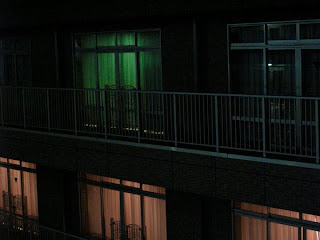
During the day I can see that the building next to me is an innocuous hospital of some sort. I see hospital beds, people in hospital beds, people shuffling around the hospital beds in hospital gowns, and hospital nurses wearing surgical face masks. At nighttime a transformation takes place and I am staying in Takinogawa, in Tokyo, in Japan, yet I am next to Dario Argento's Tanzakademie in Freiburg, Germany, from his 1977 film Suspiria. At nighttime the shuffling of feet no longer seems quite so innocent and must be coupled to the supernatural and sinister red and green illumination. Why else would the lights blink, flicker, pulse, and send me messages in Morse code? Sitting at the kitchen counter in the morning having an espresso it is exceedingly difficult to believe that the building next door is a zombie hospital, but I fear in the depths of my heart that it is true.

22
In the mornings I make my espresso with the iconic Italian stove top Bialetti Industrie Moka Express. At 4:55 JST I open the carefully constructed individual serving package and make my afternoon “Blendy” drip coffee. I drink. At 4:59 JST I set my cup down in a particular spot on the kitchen counter. I wait. At 5:00 JST the afternoon light comes through the cup perfectly and the "poignant 5 PM song" plays outside from nearby speakers. たいふうはどこですか?(taifu wa doko desuka – where is the typhoon?).


21
As with many things, the hallway in this apartment looks completely plausible either upside down, or right side up.


20
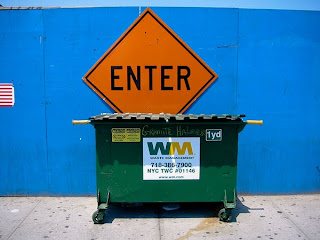
Please, come in to this one cubic yard dumpster, as today's runny, drippy garbage is tomorrow's desiccated and priceless archaeological find. From my current perspective in immaculately clean 2-32-10 Takinogawa, Kita-ku, Brooklyn strikes me as a place that is sending out a confused message, although I do admit that I have a love for garbage dumpsters. Actually, I have been inside of a three cubic yard dumpster full of trash and it was much more spacious than I thought it would be. Also, the smell was not nearly as repulsive as I expected and I wasn't even wearing a face mask. Unfortunately, I didn't find what I had accidentally thrown away into the dumpster only hours earlier. This lead me to think that possibly there was a tunnel connecting the dumpster to an alternate world of puppet sanitation workers and puppet archaeologists working side by side to decide what will be considered valuable in the future. What a lovely, precise broadcast that would be.

19
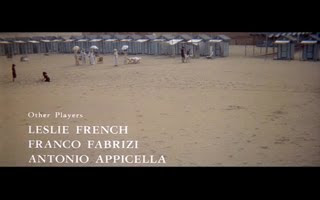
I am sitting on the 18% gray expanse of the terrace overlooking Takinogawa and thinking about Venice, Italy where Luchino Visconti made his film, Death in Venice, in 1960. In doing so I am technically thinking about death, but that is really just a trifle because I am primarilly considering that I might be related to someone who worked for Visconti. I thought that I projected something into Visconti’s film, but after rewinding the film I realized that I actually did see my last name scroll by in the end credits, albeit slightly misspelled. I am still sitting on the 18% gray expanse of the terrace overlooking Takinogawa, but now I am thinking about Tokyo in 1953 and the quotidian, and that if I could read kanji I would be able to understand the end credits for Tokyo Story and find that I might even be related to someone who worked for Yasujirō Ozu.

18
The meniscus of Pocari Sweat in a glass with condensation looks absolutely correct in front of my 18% gray card. Most everything is improved by placing it in front of the sober background of an 18% gray card; however, the astonishing nature of a meniscus reads as particularly impressive in this situation. As well, the beads of moisture form a delicate filigree that plays nicely against the ornamental restraint and temperate nature of the gray. The effectiveness of gray is continually inspiring.


17
Regarding the upcoming typhoon: there was a sudden, impromptu meeting on the terrace with the superintendent of the apartment complex who climbed over the railing to the terrace while I was taking a shower. He wanted to secure the plants and make sure the drains were unclogged and OK. I heard a voice, so I went down the hallway to the front door, then outside, but nobody was there. Then I heard a voice from the terrace, so I went inside – nobody there, but a voice from the front door, so I went back out – nobody there yet again. This repeated not unlike your average cartoon skit until I looked over onto the terrace from near the front door, saw him, and we finally spoke (we slightly spoke would be a more accurate description). I rushed out in shorts, in the rain, without contact lenses and started "hai, hai, hai-ing" to everything he said, scooping leaves and mud from the drains as I interpreted, and moving things to where he pointed. It was quite comical – my arigatous, my blindness, his arigatous, much mutual bowing and confusion, etc. I moved all the small plants towards the building and surrounded them with a ring of larger, protective plants according to my deduction of what might potentially have been his suggestions. Now watch, there probably won't even be rain later in the day. Regardless, we are ready for whatever is coming.
16
A northern station of the Toden Arakawa line – one of the last of the chin-chin (ding-ding) streetcars – is Ōji-eki-mae Station right next to where I am presently staying. In 2005 I lived in Higashi-Nippori next to the Minowabashi Station, the southern terminus of the line. A trolley that goes “ding-ding” connects my worlds of past and present not entirely dissimilar to the American television children's show host Mr. Rogers’ trolley; however, the Toden Arakawa line doesn't connect the world of Mr. Roger's living room through a mysterious tunnel with an imaginary land notable for its puppets and actual puppet monarchy, but connects two physical locations that are coincidental with my past and present. Also, the Toden Arakawa doesn't operate with the accompaniment of Mr. Rogers’ trolley's somewhat maniacal theme song. When I was a child the cycling "chugging along" relentlessness of Mr. Roger's trolley's song's rhythm always triggered a vague awareness of the inevitable forward movement of time. The Toden Arakawa doesn't have this precise effect on me, rather when I am on the Toden Arakawa I always think about Mr. Roger's trolley, how much I liked the soothing nature of the program, what a long time ago that was, and so in an elliptical manner it has the same effect, but minus the musical accompaniment. Aside from that and the evident absence of puppets on the Toden Arakawa the two trolleys seem to be more or less the same.
15
Today while I was standing in the hallway thinking about going to the local paper museum a slip of paper came halfway through the mail slot in the front door. I stood motionless in the hallway, rotating my head towards the sound and watched it enter the apartment. I was tempted to start pushing it back out, or pulling it in just to see what would happen, but I didn't. I went into the kitchen and poured a glass of ポカリスエット (Pocari Suetto) with an exceptional meniscus. The trembling upper curve of the liquid indicated that a typhoon, or something else, is getting closer. As well, the sliding glass doors of the apartment are struggling against the strong winds, rattling in their aluminum frames in protest and generating an intermittent howling.
14
Harvest moon viewing with red, green, and yellow traffic signals. Why couldn’t traffic signals be in red, green, and blue – the additive primary colors?
13
What better way is there to celebrate the autumnal moonlight viewing in Tokyo (中秋の名月 – chushu no meigetsu) than by watching golfers at a driving range? The manner in which they send their small white offerings off into the night sky is an elegant practice and I think that the moon appreciates this, welcoming the golf balls like a duck receiving its returning ducklings. Circling behind the driving range I make my way up to the screened windows and peer at the golfers from just feet away. I accompany each of their swings with a hushed imitation of a duck quack.
12
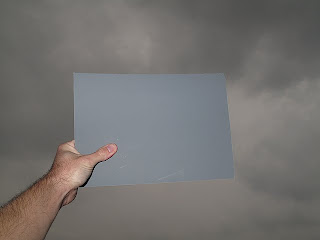
Just a few more hours and the 18% photographic gray card I am holding up will blend perfectly with the sky above Takinogawa. There will be a sudden whoosh of air, a thunderclap, and I will just look like someone with their hand raised in the air as if to ask a question. People from the neighborhood will see me doing this and yell「がんばってください!」(“ganbatte kudasai!” – do your best). When this happens I will appreciate their friendly encouragement and I will certainly do my very best.

11
Sitting on the balcony at night listening to a field recording I made earlier in the day from the very same balcony I experience the superimposition of daytime sounds on top of evening sounds forming the following unintentional composition comprised of: a Japanese heavy metal band in Asakuyama park, clicking of a bicycle wheel sprocket, small shrill birds, female voice from a loudspeaker atop a moving truck selling dumplings, scooter engine sharply clacking, guitar solo echo, muffled screams and cheers from the park, scooter pulling up, kickstand going down, screams, cheers, airplane overhead, car brake whine, bird commotion, bicycle bell ring, child in distance chatting, crow, horn, child closer talking to their mother, someone is whistling, scooter, rustling grocery bags, footsteps, bird tweets, bicycle brake screech, one bird squeak, scooter, kickstand difficulties, muted rumble of a truck, distant express train, clacking sound of wheels on rails, clacking sound of high heels, bike, birds, scooter, and walking sounds getting closer to the microphone.
10
In a local Ōji Station café they were silently projecting Austrian filmmaker Michael Haneke’s 1997 film Funny Games. It is an odd experience to be drinking an icy cold Sapporo beer, eating a tastefully spicy curry, and watching a father get methodically beaten with a golf club in front of his own child. Still, the curry was delicious and the late afternoon light streaming in the windows washed out the film projection in such a way that made it look not so much a projection, as an undulating and particularly violent portion of the wall. I ordered an espresso after my beer and settled in to study the murderous nature of some architecture.
9
The N99 face mask is finally here, along with the implication that there were 98 variants prior to this moment. Somewhere around the time of the N33 there might have been a shift in mask design from rectangles to hexagons. Somewhere around the time of the N66 it might have moved in the direction of pentagrams. What shape will we have evolved into when we arrive at the time of the N1089?


8
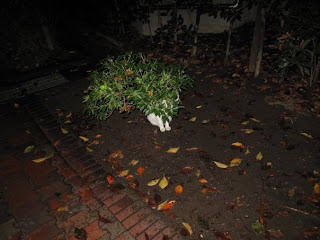
Sometimes cats in Takinogawa will use a plant as an umbrella. Sometimes cats in Takinogawa will use a plant as a stylish accessory for their evening out on the town. Typhoons, torrential downpours, misty drizzles, or even weather forecasts indicating the slightest possibility of humidity should not be considered a factor in your assessment of the situation. Feline usage of foliage is a complicated matter and goes far beyond weather predictions. Inclement weather systems can be merely coincidental with the cat's headwear decision.

7
I am quietly sitting in a Doutour cafe staring out the window and having a short espresso. I realize that the child over there in the distance carrying two cups of water down the steps – sideways, one leg, one step, one leg, one step – comes across as a cautious little crab. That one over there strikes me as a cartilaginous fish with a venomous spine based on the erratic movements, rough style of playing, and extraordinarily spiky hair – and all of this transpiring across from マクドナルド (Makudonado – McDonalds).
6
Ōji Station east to west underpass: the Doppler effect of a hiccup from a woman passing on a bike – if such a thing is even possible.
5
If the singer and songwriter Jacques Brel wrote the theme for Carol Reed's 1949 film The Third Man it would be the hatsumelo (train departure warning song) for Ebisu Station on the Yamanote line, but I have the feeling that I have said this somewhere before and that this thought will pervade everything I write from here on, like the anti-hero Harry Lime's presence before he actually appears on screen in The Third Man, or like Joseph Conrad's mysterious Kurtz lurking upriver in the Belgian Congo. Jacques Brel was a Belgian, Orson Welles played Harry Lime, and Orson Welles was going to make Joseph Conrad's novel Heart of Darkness as his first film before he made Citizen Kane in 1941, but I am uncertain of how this will all play out in regards to the looping Yamanote train.
3
While running this morning along the Shakujii gawa (river) I saw two crows in a park carefully scrutinizing a large wooden sign with a cat painted on it and a real cat standing just a foot away intently watching the crows. I wonder what the reason for the slight curl of the cat's lips indicating the presence of a knowing feline smile?
2
The Narita Airport to Nippori Station Keisei Limited Express Train’s English announcements have changed again. Not only does it sound as if the announcer has a thoroughly stuffed-up nose, but she also has the distinct inflections of someone speaking who just had braces put on their teeth and is still working out how to accommodate the new additions in their mouth. A touch of uncertainty lingers in her voice. I wonder how such a matter could slip past the producers of the announcement. Perhaps it was intentional, a strategy to subconsciously generate endearment. Regardless, I should wear a face mask so as not to catch her cold.
1.5
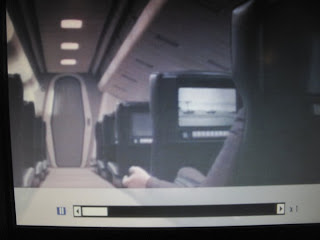
I wake up all of a sudden. It is 2009, and Stanley Kubrick's 1968 film 2001 is playing on Inflight Television on the back of the seat in front of me. I pause the film at a frame where people in the movie watch films on the backs of the seats in front of them as they travel through outer space. The main character seems to have fallen asleep. For me, this is all transpiring in a jet somewhere over the International Date Line, where today is furtively changing into the future while passengers in the film also drift in and out of consciousness. The shift back to a depiction of the future in a movie made before I was born, which accurately predicts my current state is creating a dizzying, floating sensation, which is then promptly echoed in front of me in the film when a pen weightlessly glides by in front of the camera. I decided to watch the film for a bit in slow motion and reverse, but the complex mirroring and shifting in time gave me a surprising case of the giggles. I write a brief note in my journal and place my orange pen in my shirt's left pocket, hoping it will float out in front of my face once I fall asleep.

1
東京に行きましょう!(Tokyo ni ikimashou!—Let’s go to Tokyo!). However, at this point, it is confusing whether I should use the Japanese verb for going or returning.
0 Preface

Outdoor movie theater across from Roberto Rossellini and Ingrid Bergman’s house on Via Vittorio Emanuele, Stromboli, 2006
“At last I saw the figure of Hans as if enveloped in the huge halo of burning blaze, and no other sense remained to me but that sinister dread which the condemned victim may be supposed to feel when led to the mouth of a cannon, at the supreme moment when the shot is fired and his limbs are dispersed into empty space.” 1
The following thoughts, like limbs dispersed into space then reassembled, form a loose body – rudimentary, transformed, and not entirely unified, but something with the promise of a body nevertheless.
On Thursday, March 13, 2008, I used my small pocket compass to orient my map and myself when I emerged from the Shinjuku rail station in Tokyo, Japan. There are hundreds of exits from Shinjuku station and one can easily wind up walking in the wrong direction, becoming increasingly lost and bewildered if they are not initially pointing the right way towards their destination. As in the past, my compass allowed me to fix my bearings and quickly set me on the correct course. Two days later, while traveling south from Tokyo, I stopped in the city of Osaka to see the grand sumo tournaments. Again, I utilized my compass to adjust the relationship between my map of Osaka and the city itself; however, despite the alignment of the compass rose on the map and the compass held in my palm, I was significantly off course and getting no closer to the Osaka Prefectural Gymnasium. Having become quite desperate after repeating the same, wrong route numerous times, I decided to walk in the opposite direction, concluding that my map of Osaka had somehow been printed in reverse. As I walked on this new course, the Osaka landmarks on the map quickly began to emerge in their appropriate places. I arrived at the Gymnasium and the entire matter disappeared from my thoughts as soon as the sumo bouts began.
Several days after my stay in Osaka, I arrived further south at my intended destination of Onomichi on the Inland Sea. Yet again, I encountered the problem of being significantly off course as in Osaka. I was investigating the city of Onomichi, looking for the different locations where the filmmaker Yasujiro Ozu shot portions of his 1953 film Tokyo Story and I repeatedly found myself getting terribly lost despite the use of my pocket compass. After retracing my steps back to the Onomichi rail station, I carefully compared my map with the station’s map. My map seemed to be exactly the same, so I aligned it properly according to the station map’s compass rose, and set out once again. Now, I navigated with ease to my desired sites and it gradually dawned on me that my maps had not been the source of the problem at all, but that there was something terribly wrong with my compass. Somehow, my compass had suddenly and enigmatically reversed its polarity during the previous days – north was precisely south, and south was precisely north. From my perspective, the world was now entirely upside down.
I sat for a long time in Onomichi at one of Ozu’s filming locations thinking about the implications of the world being unstable enough to abruptly invert. It was both odd, as well as comforting to be considering an enormous change such as a polarity reversal in Ozu’s own backyard, he being a filmmaker whose works are known for their fixed camera positions and methodical, steady nature. What event would be significant enough to cause a compass to rearrange its orientation? Would not such an event have enormous effects on transportation in the world and at the least merit a brief mention in the news? Additionally, what would the repercussions be for my personal life? While thinking loosely around these matters, I recollected that a compass reversing its polarity also featured in a book I had read a long time ago as a boy – towards the end of Jules Verne’s 1864 novel, Journey to the Center of the Earth.
The main characters from Jules Verne’s novel attempt to reach the planet’s core, entering the Earth via an opening in a volcano crater in Iceland. Then, at the end of the story after numerous adventures, they are ejected from the core on a wave of hot lava into a warm climate considerably different from Iceland. The chief protagonist puzzles over the changed environment and eventually concludes (after hearing Italian) that their previous proximity to the magnetized core of the planet affected the functionality of his compass, which had reversed, and that they were on the other side of the world. In fact, it turns out that that they had been expelled from the earth from a volcano on the Aeolian island of Stromboli, in the Tyrrhenian Sea north of Sicily, not back onto the volcano in Iceland. It was not precisely the other side of the world, but close enough in my book.
So far, I have not been to Iceland in my travels, or even remotely close to transiting through the inside of a volcano; however, I actually have spent time on the island of Stromboli where Roberto Rossellini made his film Stromboli in 1949. A few years earlier I stood on the island near the active volcano and considered the possibility of the explorers from the 1959 film version of Journey to the Center of the Earth – actors James Mason, Pat Boone, and Gertrude the Duck – being shot out from the volcano, out of their movie, and directly into Rossellini’s film alongside the heroine Ingrid Bergman. The science fiction of Journey to the Center of the Earth, in some ways a polar opposite of Rossellini’s hard edge realism, would form a bizarre amalgam; further, they even shared a legitimate geographic feature in the volcano. However, sitting in Onomichi, I could not piece together, cinematically at least, what the connections were to Japan and what this had to do with my compass shifting so radically.
Yasujiro Ozu’s Tokyo Story was made in 1953, Roberto Rossellini’s Stromboli was made in 1949, and Henry Levin’s Journey to the Center of the Earth was made in 1959, so there was no commonality of production year to bring the works securely together, or even legitimately into the same mental conversation. Still, I thought, if only I could arrange for a screening of Tokyo Story at the library’s outdoor theater on Stromboli, at the base of the volcano and directly across the street from where Roberto Rossellini and Ingrid Bergman lived while filming, that would be a neat suturing and provide the third side of this filmic triangle.
Upon returning home to New York from Japan, I looked further into the mysteries of magnetism and was quite surprised with the answer from the U.S. Geological Survey’s National Geomagnetism Program when they posed the following question on their website, “Is it true that the magnetic field occasionally reverses polarity?” The website then went on to say with great enthusiasm, “Yes, incredible as it may seem, the magnetic field occasionally flips over! Occasionally, however, the secular variation becomes sufficiently large such that the magnetic poles end up being located rather distantly from the geographic poles; we say that the poles have undergone an ‘excursion’ from their preferred state. During a reversal, between polarities, the geometry of the magnetic field is much more complicated than it is now, and a compass could point in almost any direction depending on one’s location on the Earth.” 2
This new information made me consider my situation quite differently. Who knows what would have happened when my compass flipped over if I had been seeking out film locations for Ozu’s Late Spring, made in 1949, or for his 1959 film Good Morning. Perhaps I would have encountered less complications, smaller variations, and found significant connections with Stromboli, or with Journey to the Center of the Earth. Nevertheless, I had been in Onomichi, Tokyo Story was made in 1953, and consequently the reassembling of dispersed limbs is not as straight as it could be, or, more truthfully, is not at all. Two lines have been joined, with the promise of a potential triangle in a distant, missing leg.
After Verne’s character emerged from the volcano’s halo of burning blaze and spotted the guide, he likened his feelings to the sinister dread of a condemned man just before “his limbs are dispersed into empty space.” If this character were to collect their senses and overcome their anxieties of the unknown, then ask the U.S. Geological Survey’s National Geomagnetism Program “What causes the magnetic field to reverse polarity?” They would be confronted with the following answers:
First, “Nothing.”
Followed by, “The fact that the magnetic field occasionally reverses is simply a property of the continuous, on-going behavior of the Earth's dynamo.”
Then, lastly and most lovely, “There is no ‘cause’ per se.”
Notes:
1 Verne, Jules. Journey to the Centre of the Earth. Trans. William Butcher. Oxford: Oxford University Press, 2008.
2 "National Geomagnetism Program Frequently Asked Questions." (April 16, 2007): U.S. Department of the Interior/U.S. Geological Survey. .
Subscribe to:
Posts (Atom)